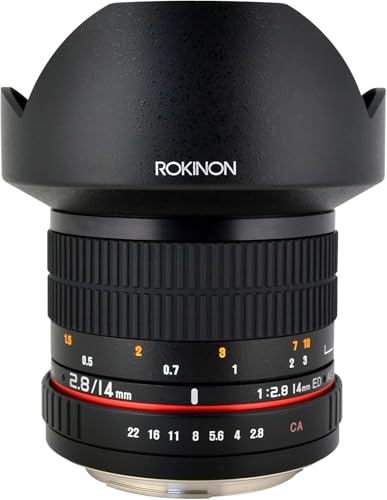
A focal length chart maps millimeter values to angle of view and typical photography uses, running from ultra-wide fisheye glass around 8mm up to super-telephoto lenses at 600mm and beyond. The ranges below are general groupings rather than fixed rules, since two lenses a few millimeters apart often serve the same purpose.
Ultra-Wide: 8mm to 20mm
This range includes circular and full-frame fisheye lenses at the shortest end, plus rectilinear ultra-wide lenses closer to 16-20mm. Angle of view is extreme, often well over 100 degrees, which makes straight lines near the frame edges bow outward unless the lens is corrected for distortion.
- Interior and architecture photography in tight rooms
- Astrophotography wide-field shots of the night sky
- Creative distortion effects and dramatic perspective
Wide-Angle: 24mm to 35mm
This is the most commonly used wide range, still exaggerating the size difference between near and far objects but with straighter lines and less obvious distortion than the ultra-wide range.
- Landscape photography that includes foreground and sky together
- Environmental portraits that show the subject’s surroundings
- Street photography and real estate interiors
Standard: 40mm to 60mm
Often called the normal range, roughly matching how a human eye perceives spatial relationships on a full-frame sensor. There is little exaggeration or compression, which is why this range is a common default for documentary and everyday photography.
Short Telephoto: 70mm to 135mm
Perspective starts to compress noticeably in this range, meaning background elements appear closer to the subject than they would at wider focal lengths. This flattering compression, combined with a comfortable working distance from the subject, is why this range is closely associated with portraits.
Telephoto: 150mm to 300mm
At this range a photographer can isolate a subject from a busy background and work from a real distance away. Compression is strong, backgrounds appear compacted, and depth of field grows shallower at a given aperture compared to wider lenses framed the same way.
- Field sports photographed from the sideline
- Wildlife that tolerates only moderate approach distance
- Candid photography where standing close would change the subject’s behavior
Super-Telephoto: 400mm and Beyond
Reserved for subjects that cannot be approached closely at all. The narrow angle of view means even small hand movements are magnified, so these lenses are typically used with a monopod, tripod, or in-body/lens stabilization, and with a fast shutter speed to keep the image sharp.
- Distant wildlife and bird photography
- Professional sports coverage from fixed sidelines
- Airshow and motorsport photography
Recommended Lens

Standard Zoom Lens